
Wagering Requirements Made Clear
Wagering requirements are not a gameplay feature. They are a balance-control mechanism built into online casino systems.
Their role is to determine when funds held within a player account are allowed to change status — from playable balance to withdrawable money.

What Wagering Requirements Actually Control
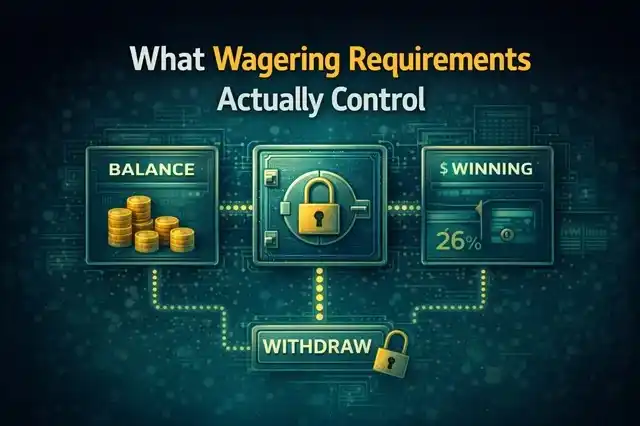
Wagering requirements are often described as something you need to “play through.”
That framing is misleading.
In practice, wagering does not control how much you play.
It controls when money is allowed to change status inside the casino system.
When a bonus is active, the balance is tracked in more than one state — even if the interface shows a single number. Some funds are usable for play. Others are eligible to leave the system. Wagering exists exactly between those states.
This is why balance ≠ withdrawable balance.
You can place bets, see wins credited, and watch the balance grow — while none of that money is yet allowed to be withdrawn. Not because something is missing, but because the system has not approved the transition.
It does not:
• care how entertaining the session is
• react to individual wins or losses
• evaluate whether play feels “fair”
Its function is purely structural: to decide when funds stop circulating inside the casino system and become eligible for payout.
This also explains why wagering feels invisible at first. Nothing about gameplay changes. What changes happens one layer below — in how the system tracks the status of money during play.
Once wagering is understood as a control layer rather than a gameplay requirement, many common confusions disappear. The rules are no longer about activity, but about readiness for release.
When Wagering Becomes Active
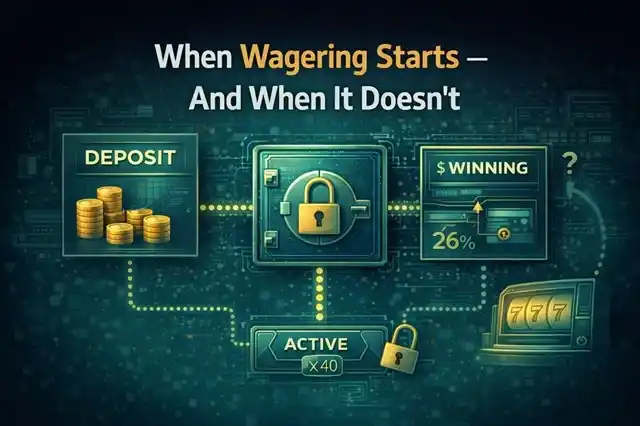
One of the most common misunderstandings around wagering is timing.
Many players assume wagering starts only after something visible happens — a win, a balance change, or a certain amount of play. In reality, wagering becomes active earlier and far more quietly.
The moment a bonus is accepted, the system assigns a different status to funds connected to it. From that point on, gameplay no longer operates under standard cash-play conditions. Every interaction with the balance is already being evaluated against wagering rules — even if the interface gives no indication of it.
This is where confusion begins.
Deposited funds, bonus funds, and winnings generated during bonus play do not behave identically. They may appear merged on the screen, but internally they are tracked under different conditions. Wagering applies not only to the bonus itself, but to when related winnings are allowed to change status.
What makes this especially misleading is the lack of clear signaling. There is no universal marker that says, “wagering is now active.” Games behave normally. Wins are credited as usual.
The difference exists entirely below the surface.
As a result, many players believe wagering has not started yet — when it has been shaping the balance from the very first action taken under bonus conditions. The absence of a warning does not mean the rules are inactive.
Understanding this timing does not change outcomes. It explains why later restrictions feel sudden, even though they were in effect from the start.
How Wagering Is Calculated (Without the Math)
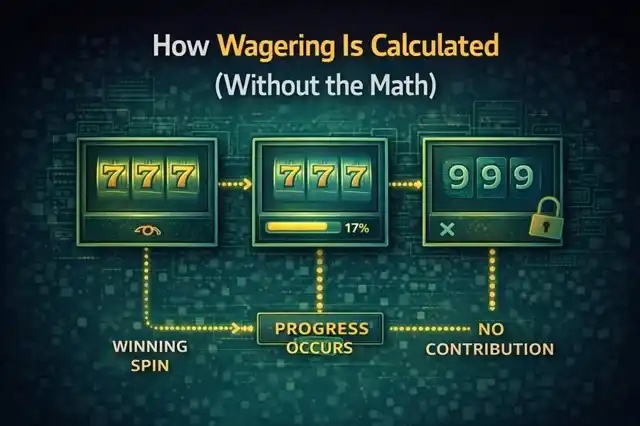
Wagering is often described as a number that needs to be “worked down.”
That description is convenient — but incomplete.
In practice, wagering is not driven by arithmetic. It is driven by qualification.
Every action taken while a bonus is active passes through a validation layer. The system does not evaluate outcomes or balance movement. It checks whether a given action meets the conditions required to move funds toward a different status.
This is why wagering behaves less like a counter and more like a process.
From the player’s perspective, two actions can look identical. From the system’s perspective, they may not be. What matters is the context in which an action occurs — the game environment, the bonus conditions, and the internal rules that determine whether progress is recognized.
If an action qualifies, progress is recorded.
If it doesn’t, the balance may still change while wagering remains unchanged.
This explains a common source of confusion: visible balance movement does not guarantee visible wagering progress.
Balance reflects gameplay outcomes.
Wagering reflects compliance with predefined conditions.
One responds immediately to wins and losses. The other updates only when specific criteria are met. The figures players eventually see are simply the surface result of that underlying process.
What matters here is not learning how to calculate wagering manually, but understanding why the system can produce outcomes that feel inconsistent on the surface while remaining internally consistent by design.
Why Some Bets Count — and Others Barely Do
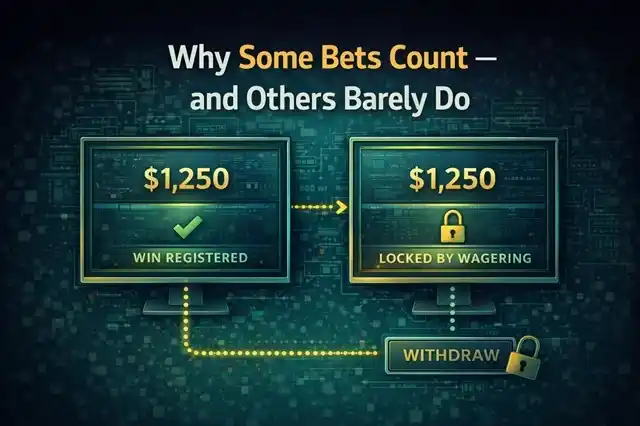
Not every action taken during bonus play contributes equally to wagering progress.
This is not a punishment and not a flaw. It is a direct result of how the system manages risk exposure, not activity.
Wagering does not measure how often bets are placed. It evaluates what kind of exposure those bets create within the bonus framework. Different forms of play introduce different levels of predictability and volatility, and the system adjusts progress recognition accordingly.
This is why wagering progress can feel uneven.
A session may involve constant interaction, visible balance changes, and frequent outcomes — while progress advances slowly. The system is not reacting to volume. It is reacting to how closely each action aligns with the internal risk model embedded in the bonus conditions.
Some actions fit that model closely and are recognized efficiently.
Others remain allowed but are intentionally weighted lower, meaning they contribute little toward changing the balance’s status.
This explains a common frustration: “I’m playing, but nothing is moving.”
In these cases, the system is not malfunctioning. It is applying reduced recognition to actions that introduce less controlled exposure from the casino’s perspective.
Once wagering is understood as a control layer rather than a reward mechanism, this behavior stops feeling arbitrary. Uneven progress is not an error — it is a structural feature of how wagering is designed to function.
Common Situations Where Wagering Breaks Expectations
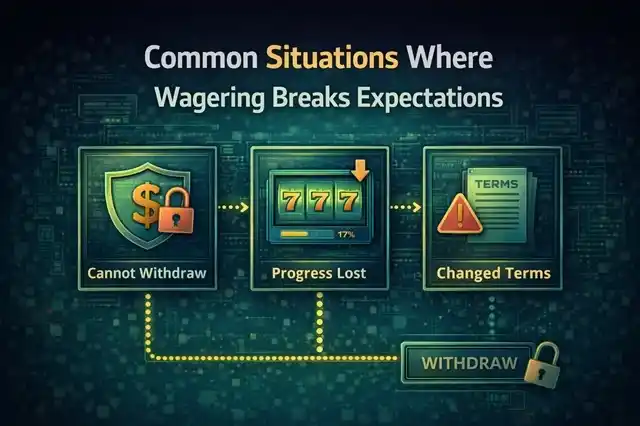
Most confusion around wagering does not come from unclear rules.
It comes from moments where system behavior diverges from what the player reasonably expects, often after time, effort, or balance changes have already occurred.
Winning Early Doesn’t Change the Process
One of the most common assumptions is that an early win accelerates wagering.
It doesn’t.
A win can increase the visible balance without changing how much of that balance is eligible to change status. From the system’s perspective, wagering continues exactly as before. The conditions that govern eligibility remain unchanged, regardless of short-term outcomes.
This is why players often feel that progress has “stalled” after a win.
In reality, nothing stalled — the system never linked wagering progress to winning momentum in the first place.
Progress Slows Even Though Nothing “Changed”
Another frequent point of friction appears when wagering progress seems to slow down or barely move, despite ongoing play.
From the outside:
bets are still placed,
outcomes still occur,
balances still fluctuate.
Internally:
the same qualification logic continues to apply,
the same weighting rules remain active,
the same conditions determine recognition.
What changed is not the system — it’s the player’s expectation of how visible activity should translate into progress. Wagering does not respond to session intensity or duration. It responds only to whether actions qualify under the predefined framework.
Progress Appears to Reverse or Reset
Some players encounter situations where wagering progress appears to move backward or reset.
When this happens, the system is not reacting retroactively or arbitrarily. It is enforcing interaction rules between balance states — especially when bonus conditions reassert control after specific triggers are met.
From a technical standpoint, this is not reversal.
It is reclassification.
Funds that temporarily appeared closer to withdrawal eligibility are reassigned to a conditional state once the underlying requirements reapply. The visible effect feels like loss of progress, but the system is simply restoring the correct status hierarchy.
Why These Situations Feel “Wrong”
What all of these cases have in common is not malfunction, error, or deception.
They share one core issue: misaligned mental models.
Players carry assumptions from regular play into a bonus environment. Wagering systems do not adapt to those assumptions. They apply the same logic consistently, regardless of momentum, timing, or perceived fairness.
Once this gap is understood, most “unexpected” outcomes stop being surprising.
They are not exceptions — they are normal results of a system designed to enforce conditions quietly and continuously.
Wagering vs. Withdrawal: The Exact Line Between Them
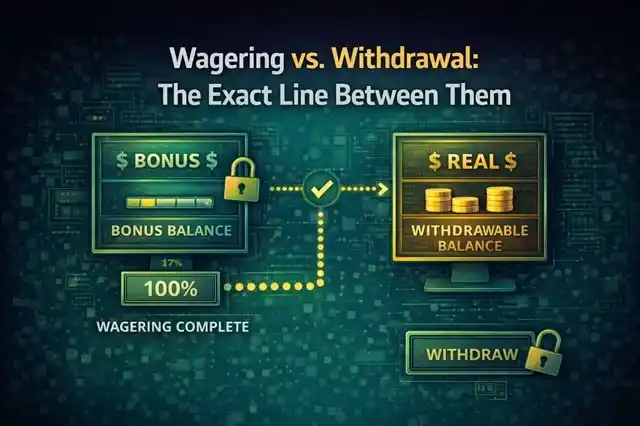
Wagering and withdrawal are often treated as parts of the same process.
From a system perspective, they are not.
Wagering determines whether funds are allowed to change status at all.
Withdrawal determines whether eligible funds can actually leave the platform.
Completing wagering does not trigger a withdrawal. It removes one specific constraint: bonus-based control over the balance. At that point, funds stop being conditionally locked by wagering rules — but they are not automatically released.
This distinction matters because wagering completion is often mistaken for freedom. In reality, it marks a transition between two control layers, not the end of control.
For wagering to stop having relevance, every bonus-related condition must be resolved. Until then, the balance remains conditional, regardless of its visible amount or recent changes.
The critical line is simple:
Wagering answers: Is this balance allowed to become withdrawable at all?
Withdrawal answers: Can this withdrawable balance be released right now?
Once wagering is cleared, responsibility shifts. Bonus logic disengages, and other system checks — independent of wagering — may apply. These checks often appear immediately afterward, which creates confusion, but internally nothing overlaps.
Completing wagering conditions does not trigger a payout. It only changes balance classification. The actual release of funds is governed separately by how casino withdrawals work inside the platform.
Understanding this separation removes a major source of frustration.
Wagering completion is a necessary condition, not a promise. It unlocks eligibility — not immediacy.
When this line is clear, the move from bonus play to cash-out stops feeling arbitrary. It becomes a defined checkpoint between two systems with different roles, rules, and authority.
When Wagering Requirements Are a Red Flag
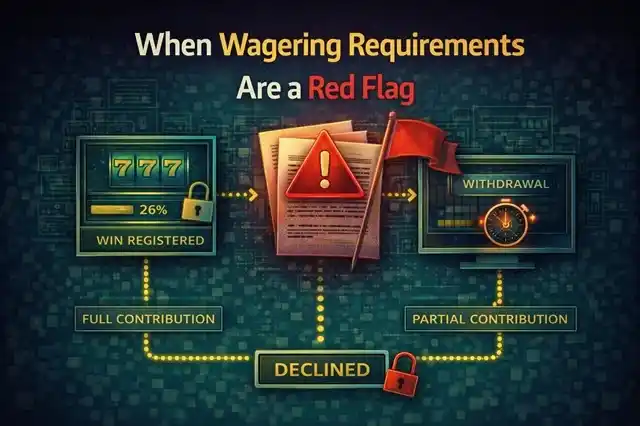
Wagering requirements are not inherently problematic.
They become a red flag only when their structure prevents players from verifying progress, predicting outcomes, or understanding when funds are supposed to change status.
At this stage, the issue is no longer how wagering works — but whether the system is designed to be auditable at all.
Signs the system is working against the player
A healthy wagering system is restrictive by design, but transparent in execution.
Red flags appear when restrictions are paired with opacity rather than clarity.
Watch for setups where:
wagering progress cannot be checked in real time or updates inconsistently,
contribution rules are referenced without being clearly tied to specific actions,
completion conditions shift depending on balance size, timing, or withdrawal attempts.
In these cases, wagering stops functioning as a control layer and starts acting as a moving gate — one that adjusts after play has already occurred.
When restrictions only surface at withdrawal
In a well-designed system, wagering affects play while it is happening.
In a problematic one, its consequences appear only when a withdrawal is requested.
If wagering-related limits suddenly become relevant only after funds are won — through delayed recalculations, partial contributions, or newly enforced caps — the system is no longer guiding behavior. It is retroactively filtering outcomes.
That behavior is not about managing risk.
Complexity vs. opacity
Complex wagering rules are not automatically unsafe.
Opaque ones are.
A reliable system allows players to answer three questions at any moment:
What actions currently count toward completion?
How close is the balance to changing status?
What exactly will change once wagering is finished?
When these answers depend on support tickets, internal reviews, or vague terms rather than visible rules, wagering requirements become a structural warning sign.
Why this matters beyond the bonus
Wagering systems do not exist in isolation.
They reflect how a platform approaches control, transparency, and dispute resolution as a whole.
If wagering rules are unclear, inconsistent, or difficult to verify, the same patterns often appear later — during withdrawals, account reviews, or compliance checks. In that sense, wagering red flags are not about the bonus itself, but about the system behind it.
In that sense, wagering rules are not just about bonus clearance, but about how a platform defines control boundaries, transparency, and escalation paths — the same platform-level safety signals used when evaluating how online casinos are classified as safe or unsafe, long before any payout is requested.
The Practical Takeaway

Wagering requirements are not designed to influence how you play.
They exist to define when funds stop belonging to the casino and start belonging to you.
- Once that line is clear, wagering stops being confusing.
It becomes a system you can evaluate — not a condition you discover too late.
Wagering requirements don’t measure how much you play — they determine when money changes ownership.