
Withdrawal Edge Cases
Sometimes a withdrawal doesn’t fail.
It just… doesn’t end.
No rejection, no approval, no clear reason — just money sitting in place while the casino keeps saying the process is ongoing. From the outside it looks like a delay. From the inside, it’s something else entirely.
This article looks at the moments where withdrawals stop behaving like decisions and start behaving like unresolved situations. Rules remain intact. What fails is the system’s ability to bring its own process to a close.

Where the Withdrawal Model Stops Being Deterministic
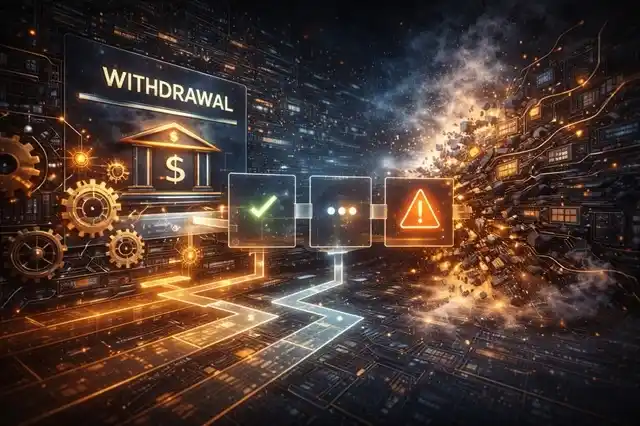
Normally, a payout request follows a recognisable path. One condition leads to another, checks resolve in sequence, and something eventually happens. The logic feels boring — and that boredom is a good sign.
Problems begin when progress stops depending on a specific requirement. The process encounters a situation it cannot categorise without contradiction.
Here, nothing is missing and nothing is broken. Each internal check returns a valid result, yet those results no longer point in the same direction. One part sees no obstacle. Another remains cautious. A third refuses to move without certainty that is neither demanded nor dismissed anywhere else.
At that point, movement gives way to hesitation. Advancing would require agreement that does not exist, while rejecting would require a reason no single layer can provide. The safest option becomes waiting, even though waiting does not resolve anything.
From the outside, this looks like time passing. Inside the platform, it is something else entirely: a moment where logic stops producing conclusions. The process remains active, but its ability to finish quietly disappears.
What follows is not failure in the usual sense. It is a withdrawal caught in a state the system was never taught how to close — valid enough to exist, yet impossible to complete.
Competing Valid States Inside a Single Withdrawal Request

Sometimes, a single request is seen through more than one internal lens at the same time. Each perspective evaluates the situation correctly, yet none of them sees a reason to conclude that evaluation.
Elsewhere, one layer treats the situation as clear, another treats it as provisional, while a third refuses to move without confirmation that is not explicitly required. Every assessment stands on solid ground. The conflict emerges only when those assessments are expected to produce one shared outcome.
Individually, these conclusions do not contradict policy or logic. Together, they form a deadlock. Progress would require one interpretation to outrank the others, but no hierarchy exists that allows such a choice to be made automatically.
Meanwhile, the platform continues to function as if nothing unusual is happening. Reviews remain open, flags remain valid, and the account remains accessible. What disappears is the ability to transition from evaluation to closure.
In the end, the request becomes trapped between correctness and completion. Nothing invalidates it, yet nothing finalises it either. The situation persists without resistance. Every participating control behaves exactly as designed — just not in coordination.
Temporal Desynchronisation Between Control Layers

Time inside casino systems rarely moves in one direction.
Some components react immediately, others update in batches, and a few wait for confirmations that arrive late — or never arrive at all. Nothing here is broken. The problem starts when these timelines stop lining up.
That drift allows a withdrawal to appear settled in one layer while remaining unresolved in another. One check might already be cleared, while a different layer still operates on an earlier snapshot that was never refreshed. From the outside it feels like hesitation.
Eventually, progress depends on alignment that does not automatically occur. Each control waits for a signal it assumes will appear, unaware that other parts of the system have already moved past that moment. No explicit stop is triggered. Everything just slows down.
From the user’s perspective, this looks like pointless waiting. Underneath, it’s overlapping timelines that never converge.
Once that separation persists, finishing the process stops being about meeting conditions and becomes a matter of restoring a common point in time. Until that happens, the withdrawal stays suspended — not because it was denied, but because the system never reached a shared present.
Withdrawals That Cannot Be Classified

Certain withdrawals reach a point where no category fits anymore.
They are not approved, not rejected, and not clearly pending in a way that points to resolution. Every check returns something valid, yet no single state explains what should happen next.
Inside the platform, classification normally depends on clean transitions: eligible or not, cleared or blocked. Problems appear when different layers report results that are individually acceptable but incompatible as a whole. One system sees funds as releasable, another still treats the account as conditionally restricted, and neither is wrong in isolation.
At that stage, the process loses its decision anchor. Rules expect a stable label to act on, but the request never settles into one. Without a definitive status, automation cannot continue, and manual intervention has no clear instruction to follow.
Instead of reaching a conclusion, the request just sits there. It hasn’t failed, but it hasn’t gone anywhere either. From the system’s point of view it is still active, yet nothing is pushing it forward. Messages sent to the player usually mirror that state — updates repeat without introducing a condition that would end the process, without pointing to what would actually make the process end.
Over time, these cases expose a structural blind spot. Systems are built to process defined states, not to negotiate ambiguity between them. When classification fails, movement stops. The framework was never designed to handle overlapping states.
In practice, such withdrawals don’t fail loudly. They fade into administrative limbo, where nothing escalates and nothing completes. The issue is not the money itself, but the absence of a rule that can finally say what the request is.
When Resolution Moves Outside the System

At a certain point, some withdrawals stop being handled by the platform itself.
Not due to escalation, but to the absence of any internal path capable of bringing the process to an end. From that moment on, the system is no longer deciding anything — it is waiting for something external to force closure.
Support then becomes the visible surface of the problem.
Messages keep coming, tickets remain open, and replies continue, yet none of it alters the underlying state. The people responding often do not control the layer where a final decision could occur, and the system they rely on no longer provides one.
Resolution shifts sideways rather than forward.
Players are directed toward patience, regulators, or payment providers, not because those parties caused the delay, but because the platform itself cannot complete the process internally. Responsibility moves outward without ever being formally transferred.
What makes this stage significant is the absence of failure. The withdrawal still exists. The account remains active. Communication continues. Yet the platform no longer owns the outcome in a practical sense, which is where broader governance failures begin to surface. Completion depends on pressure, time, or outside intervention instead of a defined rule.
Once resolution leaves the system, governance has already failed. Not loudly, not illegally, but quietly — by allowing a process involving real money to drift beyond the point where the platform can actually bring it to an end.