
How Online Casino Withdrawals Work
This guide examines what happens after a withdrawal is requested — how funds move between internal states, where control shifts, and why payouts follow a fixed sequence independent of gameplay or bonuses.

What a Withdrawal Actually Is (Inside the System)
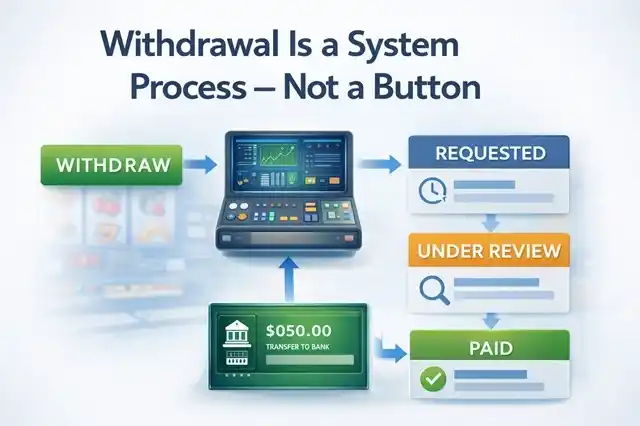
A withdrawal is not a request to “send money.”
It is a request to reclassify funds from an internal balance state to an external payout state.
From the casino’s system perspective, money exists in multiple layers long before it ever reaches a player’s bank or wallet. A withdrawal does not move funds immediately — it triggers a sequence of checks that determine whether those funds are allowed to leave the platform at all.
Internally, the system asks three questions — always in this order:
Are these funds classified as withdrawable?
Are there any active conditions still attached to them?
Can they be released under the platform’s payout rules right now?
Only if all three conditions are met does a withdrawal move forward.
This is why withdrawals feel slower and more procedural than gameplay.
They are not governed by game logic, but by financial control logic.
Seen this way, a withdrawal is not an action — it is a state transition, supervised by a different system than the one that handled play.
A withdrawal is the point where gameplay logic disengages and financial control logic takes over.
What Happens the Moment a Withdrawal Is Requested
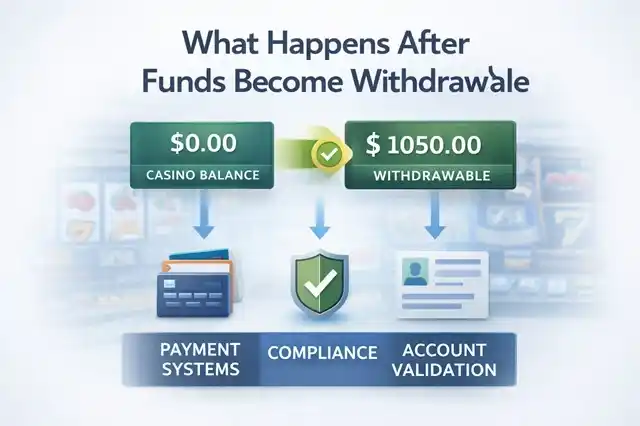
The moment a withdrawal is submitted, control shifts.
Up until that point, the account operates inside a gameplay environment. Once a withdrawal request is made, the system stops treating the balance as playable funds and starts treating it as a potential financial liability.
From this moment on, nothing “moves.”
The system freezes the balance and evaluates it under a separate set of procedural rules.
Behind the interface, three things happen almost immediately:
The balance is locked against further gameplay interaction.
The system snapshots the current account state.
The withdrawal request is queued for validation, not execution.
From this point forward, the system — not the player — controls the sequence.
This is why players often notice that funds become unavailable for play the instant a withdrawal is requested. It is not a delay tactic. It is a safeguard that prevents the balance from changing while eligibility is being verified.
At this stage, the system is no longer asking how the money was generated.
It is asking whether the account, as it exists right now, is in a state that allows funds to leave the platform.
They are handled by a different layer of the platform than gameplay — one focused on validation, not experience.
How a Withdrawal Moves Through the System
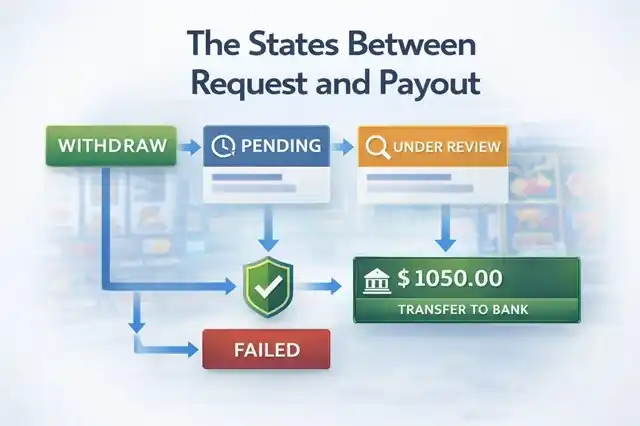
After a withdrawal request is accepted for review, it enters a non-interactive processing path.
From this point forward, the balance is no longer part of any gameplay logic. It is treated as a static financial state that must pass through a fixed sequence of checks before release is even considered.
This sequence is not flexible and does not adapt to player behavior.
In simplified terms, the system processes a withdrawal in layers:
State validation – confirming that the balance snapshot taken at request time is internally consistent and eligible to proceed.
Account verification alignment – checking whether the account status meets the platform’s withdrawal prerequisites at the moment of request.
Transaction eligibility – determining whether the balance can be converted into an outbound payment instruction.
Each layer must clear before the next one begins. Nothing happens in parallel.
Gameplay-related metrics such as return behavior or volatility are evaluated by a different system entirely, outside the withdrawal flow — as described in our guide on How RTP Works in Online Casinos — and have no authority at the payout stage. That separation is intentional.
Payout authority never depends on game performance.
Withdrawals feel deliberate because speed is no longer a priority.
Correctness is.
Delays at this stage usually mean the system is waiting for one layer to fully resolve. The process does not accelerate based on balance size, urgency, or user action. It advances only when the current condition is satisfied.
From the platform’s perspective, this rigidity is intentional. Once funds are marked for exit, correctness takes priority over responsiveness. Any ambiguity must be resolved before money is allowed to leave the environment.
This also explains why partial updates are rare.
Once funds enter the withdrawal path, outcomes are no longer shaped by how the money was earned — only by whether the account meets the criteria required for release.
Where Withdrawals Commonly Stall — and Why
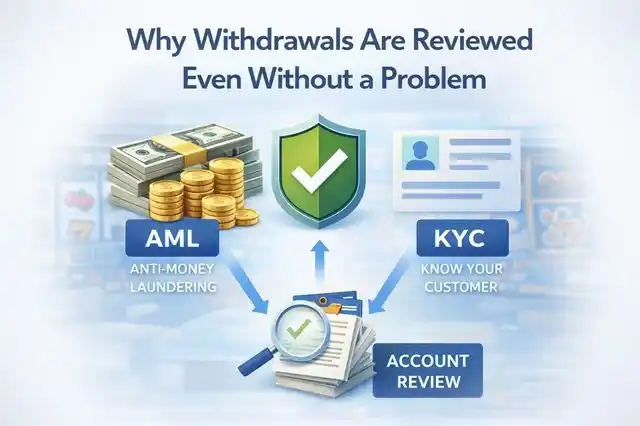
When a withdrawal does not progress, the cause is rarely mysterious from a system perspective.
What feels like a “stuck” payout is usually a pause at a specific control checkpoint, not an error or reversal.
At this stage, the platform is no longer deciding whether to pay. It is deciding whether it is allowed to finalize the transaction under its own rules and obligations.
The most common stall points fall into three categories.
Status conflicts between account layers
Withdrawal processing depends on alignment between multiple account states.
If even one layer reports an unresolved condition — for example, a pending verification flag, an unresolved restriction, or an internal mismatch — the system cannot advance.
Importantly, these checks do not escalate automatically.
A withdrawal will remain paused until the conflicting state is resolved, even if the balance itself is fully eligible. The system does not “assume” resolution based on time or previous activity.
Snapshot validation delays
Withdrawals are processed against a fixed snapshot of the account taken at the moment of request.
If the system cannot reconcile that snapshot with current account data — due to concurrent changes, delayed updates, or asynchronous checks — processing halts until consistency is restored.
This is why platforms often discourage activity after a withdrawal request.
From the system’s point of view, stability matters more than speed. Any discrepancy between expected and observed states must be cleared before funds can move outward.
External processing boundaries
Once a withdrawal reaches the point of conversion into a payment instruction, internal control gives way to external constraints.
Payment providers, banking rails, and compliance systems introduce their own processing windows. At this stage, the casino no longer has full control over timing — only over whether the request is correctly formed.
This handoff is invisible to players but critical to payout integrity.
Delays here are not negotiable and are not influenced by balance size, user status, or previous payout history.
What matters most
A stalled withdrawal is not a punishment. It is a refusal to proceed under uncertainty. None of these stall points are random.
They exist to prevent funds from leaving the system under ambiguous conditions. The platform is designed to prefer delay over error, even when that delay feels unnecessary from the outside.
A stalled withdrawal is not a judgment on the player, the win, or the session. It is a signal that the system has not yet reached a state where release is permissible under its own constraints.
Once that state is reached, the process resumes — without reinterpretation, renegotiation, or acceleration.
When Withdrawal Failure Signals a Structural Problem
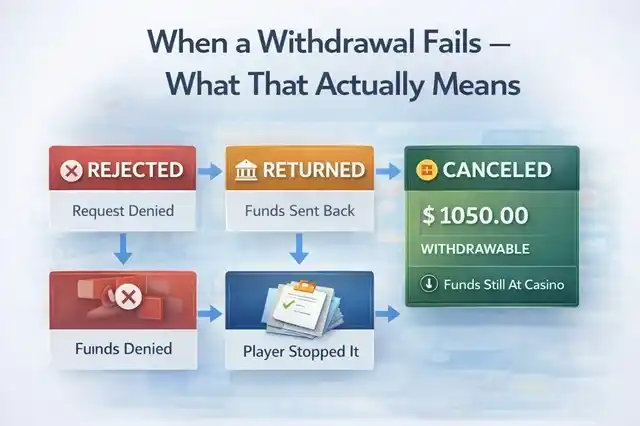
Not every delayed withdrawal is a problem.
Some are the result of normal system sequencing.
A failure occurs when the process does not merely pause, but the platform can no longer clearly explain which system state applies — and why.
Where normal control ends
In a properly designed system, every withdrawal outcome fits into one of two states:
the request is pending due to a clearly defined condition, or
the request is completed once that condition is resolved.
At that point, the issue is no longer procedural. It is structural.
Clear signs the system is not behaving correctly
A withdrawal failure is not about time, but about moments where the system loses clarity and and stops producing outcomes.
Red flags appear when:
reasons for delay change between interactions without new events occurring,
previously cleared conditions reappear without explanation,
or support responses reference internal reviews without tying them to specific system states.
In these cases, the withdrawal is no longer governed by rules — it is governed by discretion.
The critical distinction
A healthy system enforces rules before funds are released.
A problematic system applies interpretations after funds are requested.
That difference matters.
When rules activate only at the payout stage — rather than throughout the account lifecycle — they stop functioning as safeguards and start functioning as filters.
This is not a delay problem.
It is a governance problem.
Why this goes beyond a single payout
Withdrawal behavior reflects how a platform handles accountability.
This is one of the structural signals used to evaluate platform safety, especially when payout behavior reveals platform reliability under real withdrawal conditions.
If outcomes depend on opaque decisions rather than observable states, the same pattern usually appears elsewhere — during verification, disputes, or account reviews.
At that point, the withdrawal issue is no longer isolated.
It reveals who ultimately holds authority when money leaves the platform.
If the platform cannot provide those answers clearly, the problem is not the withdrawal request.
It is the system behind it.