
How RTP Functions Inside Online Casino Systems
RTP is one of the most cited numbers in online casinos — and one of the most consistently misplaced.
It is routinely discussed at the surface, while the mechanism itself operates far from any player-facing layer. That gap is not accidental. It is structural by design.
This guide examines RTP strictly as an internal system component: where it sits inside casino architecture, where its authority stops, and why projecting player expectations onto it produces persistent misunderstanding.

What RTP Governs Inside a Casino Architecture
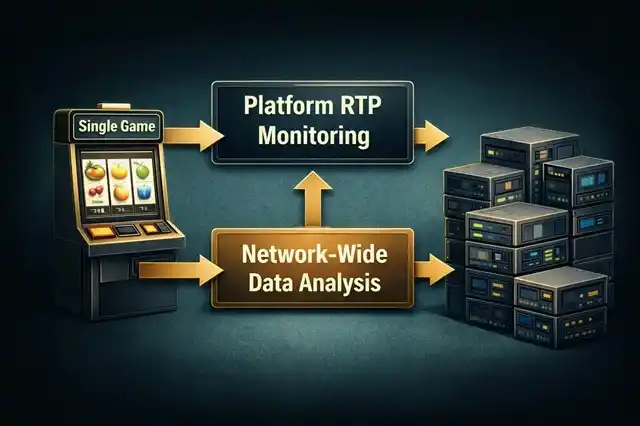
Within an online casino platform, each game is deployed with a predefined return profile that exists independently of sessions, accounts, or balances. That profile does not activate during play, nor does it respond to individual outcomes. It remains constant across all interactions routed through that game configuration.
From an architectural standpoint, this return profile belongs to the game definition layer — the same layer that determines symbol distribution, payout mapping, and mathematical behavior at scale. It is evaluated only when outcomes are aggregated far beyond the scope of a single user or session.
Crucially, RTP does not sit between a player and a result.
It sits between a game and the platform that hosts it.
This placement defines its authority. This return model describes how a game behaves as a statistical system component. It never participates in runtime decision-making and has no role in mediating access to funds, outcomes, or permissions.
What RTP Never Controls or Influences
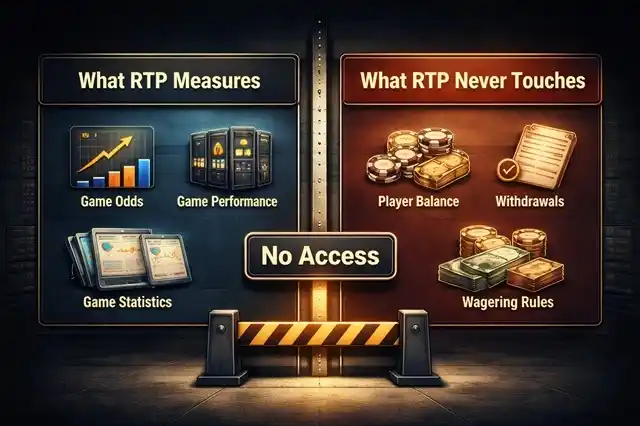
This metric has no authority over events that unfold at the player level.
Once a game is deployed, RTP does not enter the execution path of any session. It does not participate in outcome generation, balance updates, or state transitions. Those processes are resolved entirely within runtime systems designed for immediacy, not statistical description.
At the moment a spin, round, or action is initiated, RTP is already irrelevant. The game engine produces an outcome according to its internal logic. That outcome is final. No statistical parameter intervenes before, during, or after the result is produced.
Because of this separation, RTP has no interaction with:
session behavior
balance state transitions
withdrawal eligibility
Equally important, the return parameter does not correct deviations, compensate variance, or respond to perceived imbalance. Short-term outcomes — whether favorable or unfavorable — are invisible to it. There is no mechanism through which RTP “pushes back” against recent results or adjusts behavior in response to player experience.
This is not a limitation. It is a deliberate design requirement.
Allowing a statistical descriptor to influence live control flows would collapse the boundary between measurement and execution. Casino platforms therefore isolate RTP from any system that manages money, permissions, or player-level decisions.
RTP ends where player control begins.
Anything that affects how a session feels, how a balance moves, or how funds are released operates outside its domain.
How RTP Is Observed Over Time

The metric is not consulted during play at any point in the execution flow.
It becomes visible to the system only after outcomes already exist.
Every completed round produces a result that is logged, aggregated, and stored. RTP emerges from this accumulated record — not as an input, but as a purely retrospective signal. The direction is one-way: results inform the metric, never the other way around.
The platform does not reference RTP when generating outcomes, approving sessions, or resolving balance changes. Instead, it evaluates the statistical return profile across large volumes of completed activity, detached from any single user, session, or timeframe. Individual spins, short streaks, or isolated wins remain statistically irrelevant at this level.
At the system level, RTP belongs to the same analytical layer that verifies long-term consistency and regulatory conformity. It operates alongside auditing and reporting systems — far removed from live gameplay or financial decision paths, such as those governing how casino withdrawals are processed, where balances change state and authority shifts between systems
Because the game’s return profile is evaluated only in aggregate, it cannot react to volatility, compensate deviation, or “smooth” player experience. There is no feedback loop that feeds RTP back into the game engine. Outcomes are produced first. Patterns are observed later.
This separation ensures two things:
statistical parameters remain uncontaminated by player-level control logic
operational systems remain free from retrospective metrics
RTP therefore answers a narrow internal question:
Does this game behave, over sufficient volume, as it was configured to behave?
It does not answer when wins occur, how sessions unfold, or why a balance changes at a particular moment. Those events happen entirely outside its observational window.
Once RTP is understood as a post-event measurement, not a live signal, its role becomes precise — and its limitations explicit.
Who Uses RTP and For What Purpose
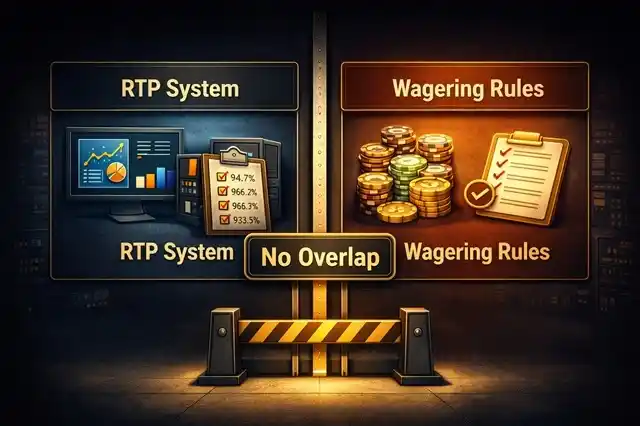
RTP exists for system owners, not for players.
Inside an online casino, RTP is consumed by a narrow group of internal and external actors whose interests are structural, not experiential. It is referenced by game providers, certification bodies, platform auditors, and compliance systems — all of which operate outside live gameplay.
Game studios treat the return profile as a design invariant. It defines the expected long-term behavior of a game configuration before deployment and becomes the baseline for later evaluation. Once published, it becomes a benchmark against which aggregated performance is later compared.
Regulators and independent testing laboratories use the same metric as a verification signal. Large outcome samples are compared against the declared statistical envelope to confirm conformity or trigger investigation. Deviations trigger investigation; conformity confirms integrity. No part of this process involves individual sessions or accounts.
Casino platforms rely on it as a post-deployment diagnostic reference. It helps confirm that a game behaves as specified under real traffic conditions, without authorizing results, adjusting volatility, or intervening in runtime decisions.
Those controls sit elsewhere in the architecture.
Crucially, RTP is never consulted at decision time.
A spin does not check RTP before resolving.
The system-level return parameter is also deliberately isolated from promotional overlays — bonuses, wagering constructs, and reward constraints operate as a separate interpretive layer, which is why RTP is frequently misread in contexts shaped by bonus mechanics, where promotional constraints introduce an additional interpretive layer unrelated to game logic.
This separation is intentional. Allowing a statistical descriptor to influence financial or permission-based flows would collapse system boundaries and compromise governance. RTP therefore remains observational by design — visible to systems that measure, invisible to systems that act.
From an architectural perspective, RTP answers one question only:
How does this game behave in aggregate, after enough outcomes exist to be meaningful?
It answers nothing about entitlement, timing, balance access, or money flow. Any interpretation that assigns it such authority comes from projecting player-level expectations onto a metric that was never built to serve them.
Why RTP Is So Often Misinterpreted
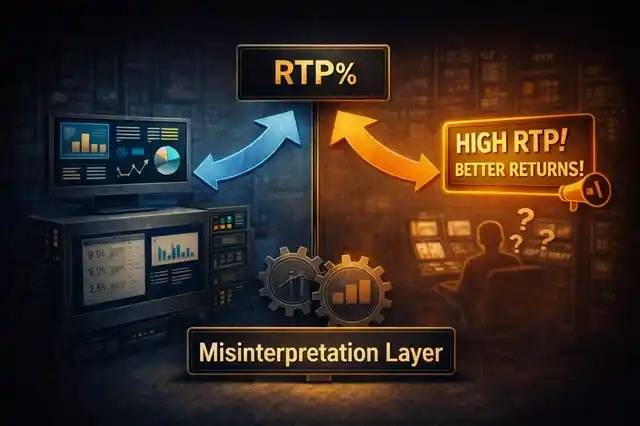
RTP is frequently misunderstood not because it is unclear, but because it is placed outside the system layer it was designed to describe.
Designed for controlled, repeatable conditions, the metric operates exclusively inside game logic rather than player-facing flows. Player experience unfolds across multiple system layers simultaneously — none of which are governed by RTP.
When outcomes from these layers are mentally merged into a single explanation,
this return model is often treated as a predictor of session behavior —
an assumption that breaks down in edge cases where RTP is asked to explain short-term outcomes.
That interpretation exceeds its scope. RTP does not describe how a session unfolds, how balances fluctuate, or how money exits the platform. It describes how a game behaves in aggregate, over time, within its own logic boundary.
In this sense, RTP is neither a commitment nor an explanatory tool. It is a narrow system descriptor — precise within its domain, and irrelevant outside of it.
Misinterpretation arises not from RTP itself, but from assigning it authority over processes it was never designed to control.
Confusion disappears the moment the metric is placed back where it belongs — not as a promise to players, but as a constraint applied to games inside a system that never evaluates how a session felt.