
RTP vs Session Reality: Where Statistical Models Lose Explanatory Power
RTP is often treated like a promise players should feel during play.
It is not designed to function that way.
The metric does not describe sessions, streaks, or outcomes that feel unbalanced.
It exists far from gameplay, inside systems that never observe individual experience.
This article explains RTP where it actually operates — and why expecting more from it leads to the wrong conclusions.

Why RTP Fails at the Session Level
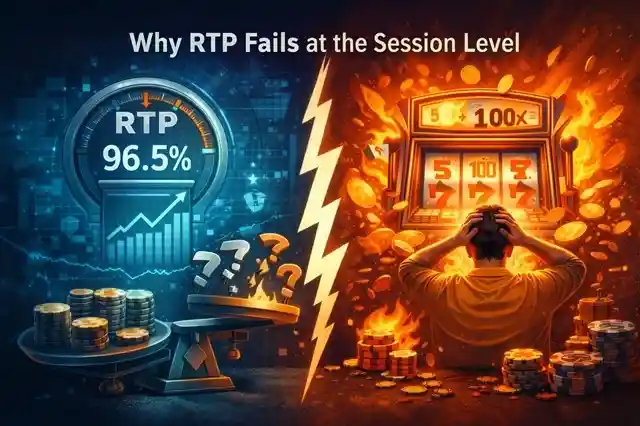
RTP stops being interpretable the moment it is read through a single session.
The number describes behaviour only after thousands or millions of completed outcomes are combined. A session, by contrast, is a tiny slice taken before any statistical shape can exist. Expecting alignment at that scale is like judging climate from one afternoon.
Nothing inside a live session references RTP. The game engine resolves results independently, without consulting historical return targets or future balance. Wins and losses occur first; statistical meaning is assigned much later, elsewhere.
That gap is the source of frustration. Players experience volatility, but interpret it through a metric that never observes individual play. RTP does not “fail” during a session — it simply never participates in one.
Volatility as the Missing Interpretive Layer

Volatility accounts for what RTP was never built to address.
Every game produces outcomes with a specific distribution pattern: how often nothing happens, how rarely big wins appear, and how long losing stretches can last. That behaviour shapes the feel of play, even though it has no impact on the long-term return figure.
High volatility concentrates value into infrequent events. Low volatility spreads it thinly across many small outcomes. Two games can share the same RTP and still behave in completely different ways over dozens or even hundreds of rounds.
Misunderstanding starts when RTP is used as a comfort metric. A player expects balance because the number sounds stable. Volatility delivers imbalance by design. Nothing is misaligned; the system is doing exactly what its payout distribution dictates.
Once volatility is recognised, short-term experience stops looking suspicious, even when outcomes feel extreme.
Why Short-Term Outcomes Feel “Wrong” Even When Nothing Is Broken
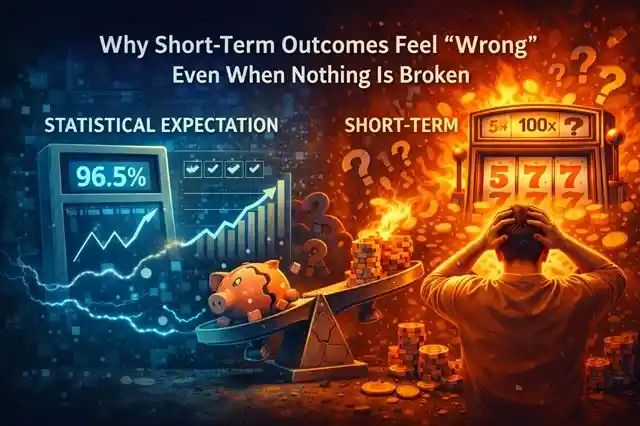
A player doesn’t experience probability as a distribution. They experience it as a sequence of moments. Five spins. Ten rounds. One evening. Meaning is assigned immediately, long before statistics have any chance to exist.
Losses feel personal when they cluster. Wins feel overdue when they don’t arrive quickly enough. Neither reaction reflects how the system works, but both feel completely reasonable from the player’s side.
Instead, the system executes rules defined long before the session begins.
No adjustment occurs mid-play. No correction waits around the corner.
What happens next is simply the next outcome, independent of what came before.
Discomfort appears when human expectation tries to impose narrative on randomness. A short run begins to feel “off” as intuition looks for balance too early. Systems never make that promise.
Once that gap is understood, the frustration stops looking suspicious. The experience feels wrong, yet nothing has deviated. The system did exactly what it was built to do — just not what intuition hoped for.
When RTP Is Used to Explain the Wrong Problem
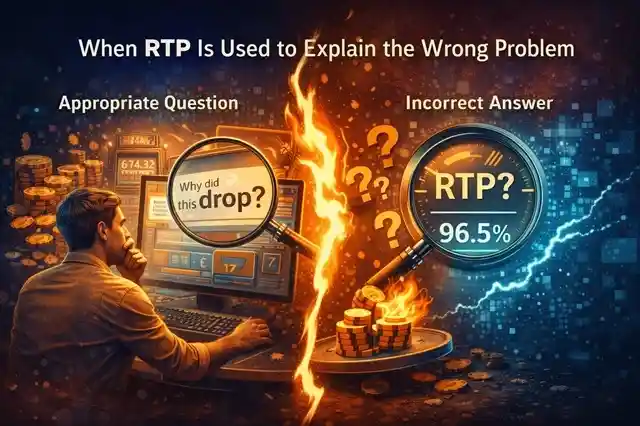
RTP often gets pulled into conversations it was never meant to settle.
When a session feels unfair, slow, or disappointing, the number becomes a convenient explanation. It sounds technical. It sounds authoritative. Most importantly, it sounds like it should have something to do with what just happened — even when it doesn’t.
The frustration people feel usually comes from the experience itself, not from the math behind the game. It’s shaped by how fast outcomes arrive, how uneven results feel, and how short runs naturally swing. RTP doesn’t describe any of that. It can’t explain timing, streaks, or why one session feels harsher than another. When those questions don’t have an answer, the real issue tends to sit higher in the system — in how decisions are handled overall, not in the game’s return model.
Using RTP in these moments creates a mismatch. A long-term system descriptor is asked to justify a short-term experience. The answer never fits, because the question itself is misframed.
This is why discussions around RTP often go in circles. Players look for meaning in the number. The system offers none. Nothing is hidden, manipulated, or malfunctioning — the metric is simply being applied outside the context where it has relevance.
Once RTP is removed from session-level interpretation, the confusion drops away. What remains is a clearer view of where experience is shaped — and where this particular number never had any authority to begin with.
What RTP Can’t Tell You — and Why That Matters

RTP can describe how a game behaves across vast numbers of outcomes, detached from individual sessions, balances, or moments of play. Beyond that boundary, it offers nothing — no insight into timing, no explanation for streaks, no guidance on what a player should expect next.
That absence matters because players often look for certainty where none exists. When a number is treated as a promise rather than a measurement, disappointment becomes inevitable. The system hasn’t failed; expectations have simply been placed on a component that was never designed to carry them.
Understanding what RTP cannot explain is as important as understanding what it does. It draws a clean line between statistical behavior and lived experience. On one side sits a long-term descriptor used by systems and auditors. On the other sits variance, volatility, and perception — forces that shape sessions without consulting any aggregate metric.
Once that line is clear, interpretation becomes easier. RTP stops being a source of reassurance or suspicion and becomes what it actually is: a background constraint on game design, not a lens through which individual outcomes should be judged.